Almost everything in a dental practice's records is health data: the odontogram, periodontal charting, medical history with illnesses and medications, radiographs, clinical photographs, consent forms. The GDPR (opens in a new tab) defines data revealing information about health status in this way (Art. 4, point 15) and generally prohibits their processing (Art. 9, paragraph 1), with exceptions including care. For the purpose of care, consent to data processing is not required: the Garante states this in general provision no. 55 of 7 March 2019, for the healthcare professional bound by professional secrecy, whether in a practice or in a facility (doc. web 9091942). It is a general clarification, not a decision on an individual case. What remains to be established is who in the practice sees what, to whom the data go out (the laboratory, for example) and how they are protected.
Odontogram, radiograph, smile photograph
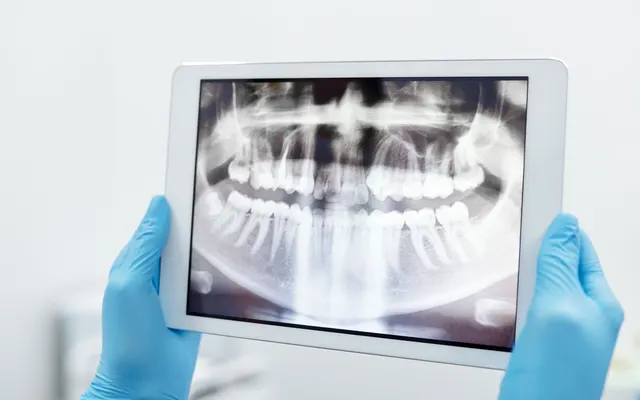
The definition in Art. 4 refers to personal data relating to the physical or mental health of a person, including the provision of health services, which reveal information about their health status. An odontogram, a periodontal chart and a medical history with reported medications fall within this without question. A radiograph or a photograph of the oral cavity of an identifiable patient shows their condition, and is subject to the same treatment. The photograph has a further distinction, that of purpose: as a clinical photograph it forms part of care, used to promote the practice it is a different processing operation.
A data map for the practice is a five-row table and serves to answer the other questions. This is an example to adapt; the "who sees it" column is your decision, not a rule.
| Data | Where it originates | Who sees it in the practice | May go out to |
|---|---|---|---|
| Medical history: illnesses, medications, allergies | First visit | Dentist, hygienist | Specialist to whom you refer the patient |
| Odontogram and periodontal chart | Visit and appointments | Dentist, hygienist | Another dentist, at the patient's request |
| Radiographs and clinical photographs | Appointment | Dentist | Specialist, laboratory if needed |
| Signed consent forms | Before treatment | Dentist, reception for filing | The patient, if they request them |
| Prescription for the laboratory | After the impression | Dentist | Dental laboratory |
Assistant, hygienist, reception: who opens which record
The Garante cites the condition in Art. 9, paragraph 3: processing for care purposes is carried out by a professional bound by professional secrecy, or by another person who is also bound to secrecy, under the responsibility of the former. The Code of Deontology, at Art. 10, states that the physician informs co-workers of the obligation of secrecy and requires its observance. The GDPR, at Arts. 29 and 32, paragraph 4, adds that anyone acting under the authority of the controller and having access to the data processes them only on the controller's instructions.
Assistant, hygienist and reception carry out different tasks, and instructions, preferably in writing, state for each role which data are accessed and why. A 2014 review of dental records describes one possible division: reception notes telephone calls, prescription changes and appointments; the assistant notes the patient's observations, medical history, radiographs taken and instructions given; the dentist adds clinical impressions and treatments, and remains ultimately responsible for the record. It comes from a scientific paper, not an Italian rule, but the principle is clear: each person sees and writes what they need for their task.
In the software, access is decided when you invite a co-worker, by choosing a role. Some roles see all the practice's patients, others only their own; reception sees patients and the diary without opening clinical records. In the list of roles in the manual there is none called dental practice assistant or dental hygienist: you choose, from those available, the role with the most restricted access that suffices for the task. Two-factor authentication is mandatory for every invitee. When someone leaves the practice, Remove access closes it immediately, open sessions included, and clinical data remain attributed to whoever wrote them. The access log, which only the administrator can open, shows who viewed a record and when: you need it if a patient asks. The rest is in users and permissions.
The dental laboratory: recipient or processor
The Garante's provision does not name the dental laboratory: it discusses legal bases, privacy notices, data protection officers and the record. The general rules therefore apply to the laboratory.
When you send it a prescription or an impression with a patient's data, the laboratory is a recipient (Art. 4, point 9). If it processes that data on behalf of the practice it is a processor (Art. 4, point 8), and Art. 28 then requires a contract or written instrument binding it: to process data only on documented instructions, to adopt the measures in Art. 32, to delete or return them at the end of the work. If instead it determines purposes and means itself, it is an independent controller. The trade itself does not say which of the two it is. The EDPB guidelines (points 21 and 26) repeat that the role is established by analysing the facts and the activities carried out, and that the same entity may be a controller for certain operations and a processor for others. For your laboratory, the privacy consultant answers on the basis of the actual relationship, and the answer must be put in writing.
What remains is the choice of which data to send. The medical devices regulation (Art. 21 and Annex XIII, point 1) provides that the manufacturer's declaration for a device made for a single patient identifies them by name, an acronym or a numerical code. The principle of minimisation (Art. 5, paragraph 1, letter c) requires data limited to what is necessary: if a code is sufficient for the laboratory to make the device too, sending that is consistent, and whether it suffices you decide with the laboratory. The code does not make the data anonymous. Art. 4 considers identifiable anyone who can be identified even by a number, and you, who know who it corresponds to, still hold personal data. Device documentation and what is retained are discussed in retention of dental documentation.
In Fibonacci the laboratory is a field in the device record, alongside the declared materials and the number of the declaration of conformity; the file received is uploaded among the patient's Documents.
What Article 32 requires
Measures appropriate to the risk, including encryption, the ability to ensure confidentiality, integrity and availability, the restoration of data after an incident and periodic verification. There is no closed list. The 2014 review has simpler requirements for a dental record: passwords to access data, records never left unattended, a backup from which to recover data if the system fails.
The questions a consultant asks about the software supplier (where the data are, who is the controller, how they are encrypted, who can read them, backups, exit) have their own page: security and data.
A checklist for the practice
- Data map: which data, where they originate, who sees them, to whom they go out
- Instructions per role: assistant, hygienist, reception
- Role of each co-worker in the software, with the most restricted access that suffices
- Access removed the same day for anyone leaving the practice
- Laboratory: role decided with the consultant, contract or written instrument if it is a processor
- Data sent to the laboratory: only what is needed, name or code decided
- Record of processing activities maintained
- Privacy notice given to the patient